

Best electric skateboard for off-road trails and bush tracks

Off-road electric skateboarding is harder on gear than most riders expect
Most boards that claim all-terrain capability are really just street boards wearing bigger wheels. They can handle a gravel path or a mowed lawn, but push them onto a real trail and the cracks start to show. Literally, sometimes. Narrow truck widths that feel planted on asphalt become a liability when the ground starts moving under you. Batteries sized for commuting run out of headroom when you are climbing loose dirt switchbacks. And flex decks, however good they feel on concrete, introduce unpredictability when the terrain itself is already unpredictable.
Genuine off-road riding asks for something built differently from the ground up. Not a street board with a conversion kit bolted on, but a machine where the geometry, the drivetrain and the platform were all designed with the assumption that the ground beneath you will not behave.
What changes when you leave the pavement
Sealed surfaces are forgiving. They are consistent, predictable and flat in the ways that matter. Off-road terrain is none of those things. The physics of electric skateboarding shift significantly when you factor in loose gravel, embedded roots, cambered fire roads and soft grass. You need more lateral stability to stay upright when a wheel catches a ridge. You need more torque to push through resistance rather than just spin wheels. And you need braking that can modulate without locking up on a descent.
Truck width matters more than most people account for. A wider stance lowers your effective center of gravity and makes the board far more resistant to the lateral forces that uneven terrain constantly introduces. It is the same reason a wider ski feels more stable on variable snow than a narrow carving ski. The geometry does the work before your legs even have to compensate.
The deck platform matters too. Rigid is better in this context. On the road, flex is pleasant. Off-road, flex introduces a half-second lag between your input and the board's response. When you are navigating a rocky descent in real time, that lag compounds into instability.
The Renegade Diablo was built for exactly this
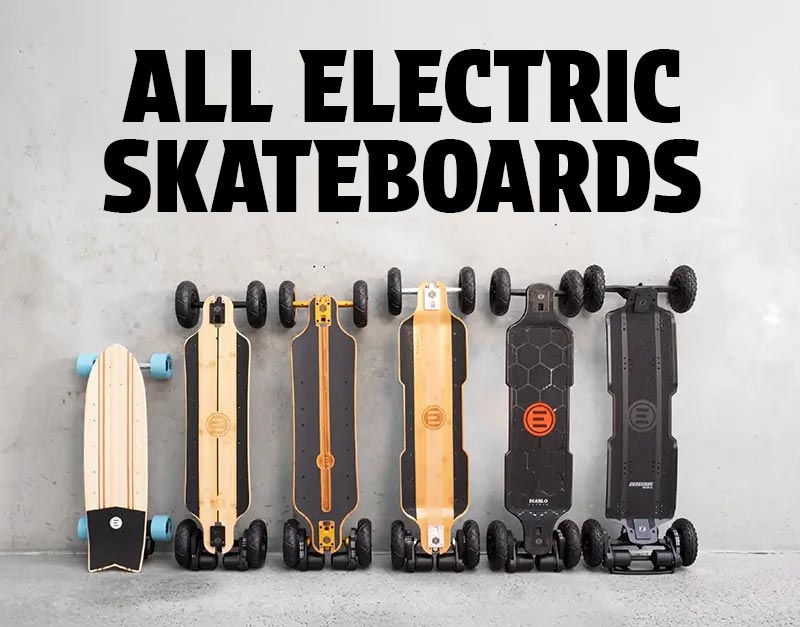
The Renegade Diablo is Evolve's purpose-built off-road board, and the distinction from the rest of the lineup is meaningful. Where other Evolve boards offer all-terrain as a configuration option, the Renegade exists specifically for riders who want to go further off the beaten path and need a platform engineered to match that intent.
Start with the trucks. The Renegade runs a forged and CNC-machined truck set at 39 cm wide, significantly wider than the SuperCarve 2.0 trucks found on the rest of the range. That extra width is not a styling choice. It directly changes how the board handles lateral pressure from uneven ground, and it gives you a more confident, planted stance when you need to absorb an unexpected input from the terrain.
The deck is solid carbon fiber. No flex. The rigid platform keeps your input direct and immediate, which means when you shift your weight to manage a tricky section, the board responds without any delay built into the structure. At 95 cm long with a 38-inch wheelbase, it is slightly shorter than the bamboo Diablo variants, which helps with maneuverability through tighter trail sections without sacrificing the stability the wide trucks provide.
Power comes from dual 3500W brushless sensored motors, running through EFOC 2.0 motor control. That is 7000W total, paired with the same 864Wh Samsung 50S battery pack that powers the flagship Diablo range. Off-road range is rated up to 50 miles, though real-world figures on technical terrain will naturally vary depending on gradient and surface. The hill gradient rating sits at 45 percent, which covers the kind of steep fire roads and trail climbs that would immediately strand a lesser board.
Why the binding option matters more than it sounds
The Renegade is compatible with optional toe and heel strap bindings, and this is worth taking seriously if you plan to ride anything genuinely aggressive. Bindings change the relationship between rider and board in a fundamental way. Instead of relying entirely on foot pressure and friction to stay connected through rough sections, you are physically anchored to the platform. On a loose downhill stretch or a rooted trail surface, that connection gives you control you simply cannot replicate with grip tape alone.
You can run just toe straps if full heel bindings feel like too much commitment, which is a reasonable way to start. But riders coming from snowboarding or surfing will recognize the logic immediately. The more technical the terrain, the more you want that locked-in feel.
Where American riders are taking it
In Los Angeles, the trails around Griffith Park and the Santa Monica Mountains offer a range of terrain that rewards a capable off-road setup. Riders in the Bay Area have access to fire roads and gravel paths throughout the hills that are genuinely demanding on gear. Austin's greenbelt trail network provides loose, rocky terrain that separates real off-road boards from overpromising ones quickly. Even in Miami, where the terrain is flat, the variety of unpaved surfaces in parks and coastal paths shows up the difference between a board that handles it cleanly and one that just gets by.
The Renegade weighs 36 lbs. That is heavier than a street setup, and it is worth being honest about that. This is not a board you carry for long stretches. It is a board you ride. The weight reflects the battery capacity, the wide forged trucks and the solid carbon platform. For trail use, that trade-off is sensible.
Is this overkill for casual riders
If your off-road riding mostly means occasional gravel paths between sealed stretches of road, the Renegade is more board than you need. The Diablo Bamboo All Terrain or the Fusion 2-in-1 would serve that use case well and give you the flexibility to run street wheels when conditions suit. The Renegade makes the most sense when off-road is the primary use, not an occasional detour.
But for riders who specifically want to explore trails, push into bush tracks, climb fire roads and ride in conditions where the terrain is genuinely variable, the Renegade is the only board in the Evolve lineup built with that as the core assumption rather than an add-on.
If you are based near Oceanside, CA, you can see the Renegade in person at the Evolve store and talk through your specific riding context before committing. For trail riding, getting the setup right before you head out is worth the conversation.
The honest answer to whether you need the Renegade is simple: if you have been holding back on the trails because your current board feels like it is at its limit, this is the one that removes that ceiling.
-
Posted in
electric skateboard, evolve
