

Best electric skateboard for snowboarders in the off-season
What snowboarders actually want from a board when the mountain closes
The off-season is a longer problem than most snowboarders admit. Depending on where you live, you are looking at five to seven months with nothing underfoot that feels remotely like what you spent all winter chasing. Skateparks exist. Longboards exist. But most of them feel like a consolation prize, not a substitute. The carve is wrong, the terrain is wrong, and the feedback loop that makes snowboarding addictive simply is not there.
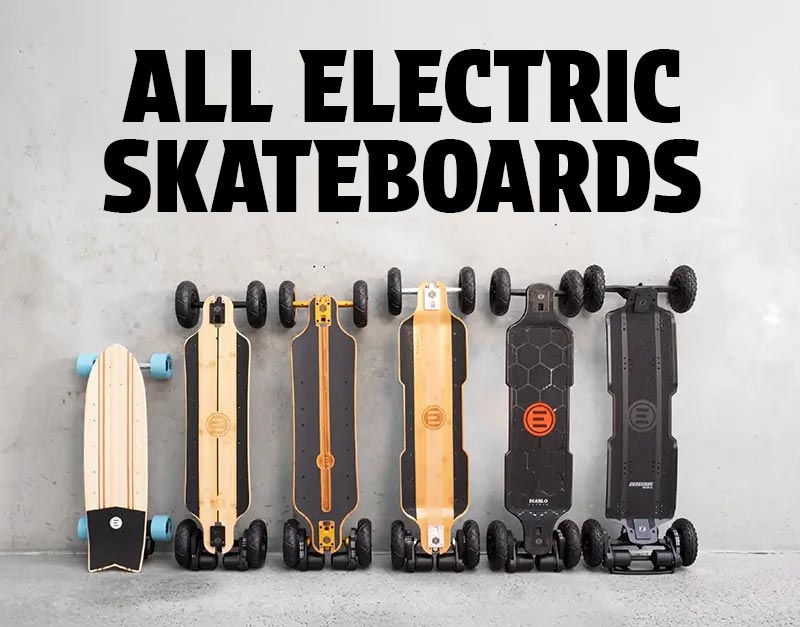
What snowboarders are actually looking for in the off-season is not a skateboard. It is something that replicates the specific sensation of riding: the way a board responds to edge pressure, the controlled slide into a tight turn, the confidence that comes from a wide platform you can really drive. Most electric skateboards are built for commuting or speed runs. The Renegade Diablo is built for something closer to what happens on a mountain.
Why the setup matters more than the top speed
Snowboarders tend to gravitate toward electric skateboards for the obvious reason: motor-assisted pushing means you can focus on technique instead of flatground survival. But the boards that get recommended in most guides are optimized for pavement, not the kind of loose, unpredictable surfaces that keep riding interesting. Flat concrete is fine for commuting. It is not where you develop feel.
The Renegade Diablo runs 175mm pneumatic all-terrain tires. On packed dirt, gravel, grass, or mixed surfaces, those tires behave in a way that urethane street wheels simply cannot. There is give. There is a feedback texture that makes you adjust your weight and stance actively, the same way snow forces you to be honest about your center of gravity. That is not a coincidence in the design. It is the point.
The stance geometry reinforces it. The Renegade's trucks are the widest in the Evolve lineup at 39 cm, and the deck comes in at 95 cm long with a solid carbon fibre construction. That combination produces a riding platform that feels stable and planted without being sluggish. Snowboarders who have spent years developing strong hip rotation and edge-to-edge transitions will recognize the body mechanics immediately. It is not skateboarding. It is closer to carving a groomed run at moderate speed, except the run can be a fire road in the hills above Los Angeles or a park path in Austin.
The terrain is the training
One of the underrated advantages of all-terrain electric riding is that you stop treating the surface as the enemy. Street skating rewards smooth asphalt. The Renegade rewards engagement with whatever is in front of you. Gravel that would pitch a street board sideways just becomes texture. Grass transitions that would stop most boards dead are manageable at appropriate speed. Packed dirt trails that cut through parks in San Francisco or Austin give you something that actually changes underfoot the same way variable snow does.
That variability is what keeps the skill transfer honest. If you are only ever riding glassy pavement in eco mode, you are getting exercise but you are not maintaining the reactive balance that snowboarding requires. The Renegade puts you in situations where you have to respond, lean into turns with commitment, and trust the platform. That is a more useful off-season tool than it might initially sound.
The 45% hill gradient capability matters here too. Riders in New York, San Francisco, or anywhere with real elevation in the surrounding terrain can actually climb and descend meaningfully. The dual 3,500W motors produce 7,000W total, and the 864Wh Samsung battery holds voltage under load rather than tapering off mid-hill. The riding feels consistent from the top of a climb to the bottom, which is exactly what you want when you are trying to develop repeatable technique rather than just survive the descent.
Weight, control, and the binding question
The Renegade weighs 36 lbs. That is not a board you forget you are standing on, and it is worth being honest about that. Carrying it up stairs or loading it into a car requires some commitment. But underfoot, the weight works in your favor. The board does not get deflected by surface irregularities. It tracks through loose material with a steadiness that lighter boards cannot match, and that stability at speed is exactly what snowboarders are wired to appreciate.
There is also a binding option. Optional Renegade bindings with toe and heel straps are sold separately and are compatible with the board. For riders who want the closest possible translation of snowboard body mechanics onto a wheeled platform, bindings change the experience significantly. You can drive the board with your whole lower body rather than relying purely on foot pressure. You can approach steeper descents with more confidence. You can push the carving harder because you are genuinely connected to the deck. It is an optional addition, but for serious off-season training purposes it is worth considering.
Where to actually ride it
In Miami and Los Angeles, flat coastal paths work fine for learning the board and building comfort with the remote and braking. But the more interesting riding happens when you find elevation. The hills above LA offer fire roads and trail access that translate the Renegade's capability into actual challenge. Austin's greenbelt and surrounding trail systems give you mixed surfaces and enough technical variation to stay engaged. San Francisco's proximity to Marin and the peninsula puts genuine off-road terrain within reach of the city.
The 50 km/h top speed and up to 31 miles of range on the all-terrain setup means you are not restricted to short loops. A serious trail session, a mixed-surface cruise, or a long hill climb and descent all fall well within the battery's capability. Charge time is four hours, which fits comfortably within a day out if you have access to a power point at the trailhead or a vehicle.
If you want to see the board in person or get hands-on advice before buying, Evolve's US store is in Oceanside, CA. That proximity to Southern California trail and coastal terrain is not accidental. It is the kind of riding the Renegade was designed around.
An honest read on who this is for
The Renegade Diablo is not the right board if your primary use case is commuting or smooth-surface cruising. For that, the Fusion or Diablo Bamboo are better fits and meaningfully easier to carry. The Renegade is for riders who want terrain, not pavement. Riders who find flat riding boring because they are used to a mountain making decisions for them.
Snowboarders who are honest about what the off-season actually needs tend to arrive at that conclusion eventually. The question is whether you get there after spending money on the wrong board first, or whether you buy the setup that actually keeps the skill sharp from the start. The Renegade is built for the second group.
-
Posted in
electric skateboard, evolve
