


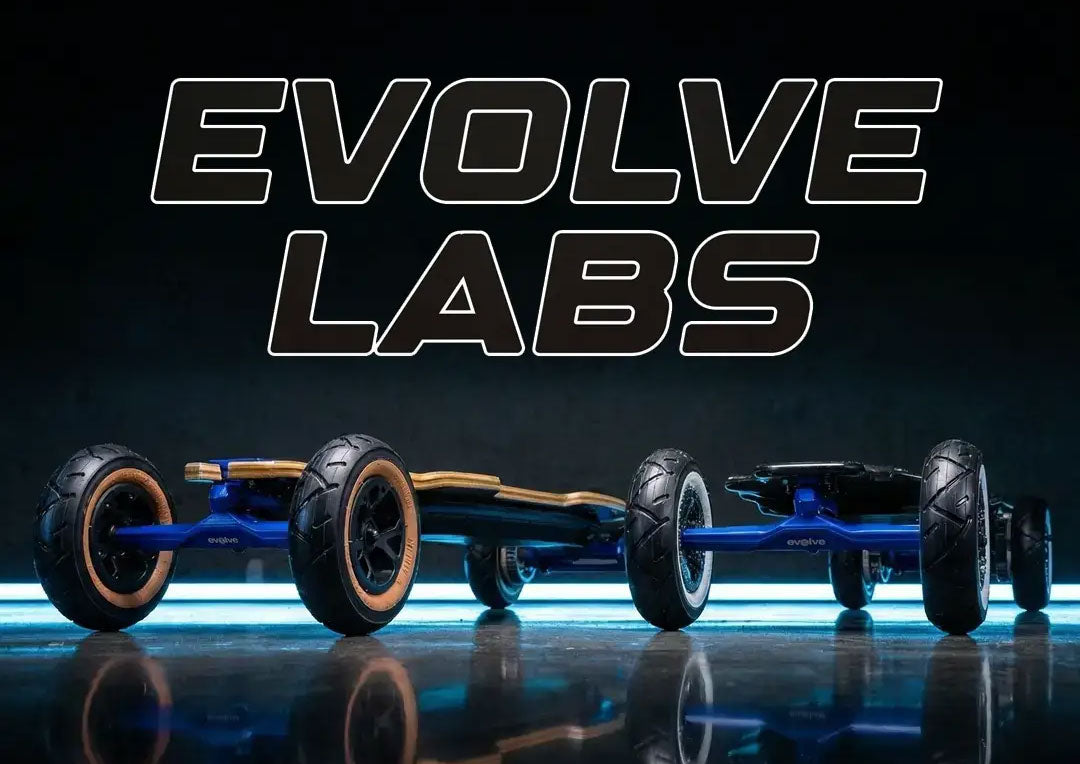
How far can the Diablo Carbon AT go on one charge?

How far can the Diablo Carbon All-Terrain go on one charge?
On all-terrain wheels, the Diablo Carbon All-Terrain delivers up to 50 miles of real-world range on a single charge. That figure comes from an 864Wh Samsung 50S battery pack, which holds voltage consistently under load rather than dropping off mid-ride the way smaller batteries tend to do.
Range is one of the most searched questions about any electric skateboard, and it is also one of the most misunderstood. The spec sheet number and the number you actually see on a ride are different things. Here is what shapes that gap and what you can realistically expect from the Diablo Carbon AT.
What the 864Wh battery actually means for range
The 864Wh battery in the Diablo Carbon is the largest in the Evolve lineup. For context, most mid-range electric skateboards run 400 to 600Wh. The extra capacity does two things: it extends your riding distance, and it maintains consistent power delivery further into the charge cycle.
On a smaller battery, you might notice speed and torque trailing off in the final third of a ride. The 864Wh pack resists that. You get predictable acceleration and braking from the first kilometer to the last, which matters especially on uneven terrain where you rely on the motors for stability.
The board is rated for up to 50 miles on all-terrain wheels. On street wheels, that figure rises to 50 miles as well, though the character of the ride changes. All-terrain tyres create more rolling resistance, which draws more energy, but the large battery absorbs that cost without meaningfully reducing usable distance.
What actually affects your range
Rider weight, terrain, speed mode and tyre pressure each pull the real-world figure in different directions. A 200 lb rider on steep trails in Corsa mode will cover noticeably less ground than a lighter rider cruising fire roads in Sport. Neither result is wrong, they are just different inputs into the same system.
A few factors worth understanding:
- Tyre pressure: The 7-inch pneumatic tyres run best at 40 to 45 PSI. Under-inflated tyres increase rolling resistance and cut range faster than almost any other variable.
- Speed mode: Eco mode is efficient. Corsa mode draws hard on the battery. For long-distance mixed rides, Sport gives a good balance of performance and range.
- Terrain: Flat fire roads are efficient. Technical singletrack with constant acceleration and braking burns through charge faster. Hills draw the most power, though regenerative braking on descents returns some of that energy.
- Rider weight: The board is rated to 265 lbs. Riders near that limit will see reduced range compared to the spec sheet, which is measured under controlled conditions.
How range plays out in real riding environments
In Los Angeles, where riders mix paved bike paths with packed gravel trails in Griffith Park or the LA River, the Diablo Carbon AT handles the transition without needing a wheel swap. A typical mixed session covering 20 to 30 miles barely touches the battery.
In San Francisco, the combination of steep climbs and long flat stretches tests any board's range management. The dual 3500W motors climb 45 percent gradients without thermal throttling, and the regenerative braking on downhills puts energy back into the pack. For riders doing hilly commutes mixed with trail riding, the large battery removes the mental math from route planning.
In Austin, where riders often access long limestone trail systems, a single charge is more than enough for a full day's ride. The 50-mile ceiling with all-terrain wheels gives a meaningful buffer even after accounting for aggressive riding and mid-session stops.
For riders in Miami or New York using the board on sealed coastal paths or park routes, the street wheel configuration extends range further still, making the Diablo Carbon All-Terrain equally capable in urban riding contexts as it is on dirt.
Carbon deck versus bamboo, and why it matters for this kind of riding
The Diablo Carbon uses a forged carbon fibre deck with an integrated CNC heatsink. That heatsink is not a cosmetic detail. On long all-terrain rides where the motors are working hard, thermal management affects sustained performance. Better heat dissipation means the system holds its output more consistently across a full charge cycle.
The rigid deck also changes how the board feels at higher speeds on rough terrain. There is no flex to dampen, which means what you feel through your feet is direct and predictable. For riders who want confidence at speed on uneven ground, that rigidity is an asset. Riders who prefer a softer, more forgiving underfoot feel will find the Diablo Bamboo more natural. Different tool, different preference.
The carbon version also comes in lighter at 31 lbs compared to the Bamboo at 33 lbs, a meaningful difference when carrying the board.
Charging and how to protect battery longevity
The Diablo Carbon charges fully in around 4 hours with the included 5A fast charger. For everyday use, most riders charge after each session and disconnect once full rather than leaving it plugged in overnight. For longer storage, holding the battery at 40 to 50 percent charge and topping it up every month or two extends cell life considerably.
The Samsung 50S cells are chosen for their energy density and discharge performance. They are the same cells used across the full Diablo and Renegade lineup, so they are well-proven under real riding conditions.
People also ask
What is the range of the Diablo Carbon All-Terrain?
The Diablo Carbon All-Terrain is rated for up to 50 miles on all-terrain wheels and up to 50 miles on street wheels. Real-world range varies based on rider weight, terrain, speed mode and tyre pressure.
Does the Diablo Carbon have regenerative braking?
Yes. The EFOC 2.0 motor controller uses regenerative braking to recover energy on downhills and during deceleration, which contributes to overall range on hilly terrain.
How long does the Diablo Carbon take to charge?
Approximately 4 hours from flat using the included 5A fast charger.
Is 50 miles realistic or is that a lab figure?
The 864Wh battery gives the Diablo Carbon genuine long-range capability, but real-world results depend on conditions. Riders covering varied terrain in Sport mode at mixed speeds report figures well above 30 miles with capacity to spare. The rated 50 miles reflects optimal conditions, but even at 70 percent of that, the board covers serious distance.
Can heavier riders use the Diablo Carbon AT?
Yes. The Diablo Carbon All-Terrain is rated to 265 lbs. Riders near that weight will see some reduction in range and acceleration compared to lighter riders, but the board handles the load and still climbs 45 percent gradients.
The honest answer on range
If you want a number to plan around: expect 30 to 45 miles of real-world range on all-terrain wheels under normal mixed-use conditions. The 50-mile ceiling is achievable on flat, efficient terrain with a lighter rider in a conservative speed mode. The floor rises with careful tyre pressure, smart mode selection and smooth riding technique.
For most riders, the Diablo Carbon AT removes range anxiety from the equation entirely. You can plan longer rides without calculating whether you will make it back. That is what a large battery actually buys you, not just a higher number on a spec sheet, but the freedom to ride without the mental overhead.
-
Posted in
electric skateboard, evolve
