

What makes Diablo different from older electric skateboards?

What makes the Diablo a different kind of electric skateboard
Most electric skateboards feel like a motor bolted onto a longboard. The Diablo Bamboo Street was built from the ground up with performance as the starting point, not the afterthought. The gap between it and older-generation boards is wider than the spec sheet suggests.
Here is what actually changed, and why it matters when you are riding rather than reading a product page.
The battery is in a different league
Older boards shipped with 10S4P packs built around 18650 cells. They worked, but voltage sag under load was a real issue, particularly on hills or when pushing hard out of a corner. You would feel the board soften exactly when you needed it to stay sharp.
The Diablo runs a 43.2V, 864Wh pack using Samsung 50S cells. That is not just a bigger number. The 50S cell chemistry holds voltage more consistently under load, which means the board feels the same at mile 30 as it does at mile one. Real-world range on street wheels is up to 50 miles, which is a meaningful jump from the 30 to 35 miles that most older boards delivered on a good day.
For riders doing longer coastal rides in Miami or commuting across the bridge in San Francisco, that range headroom changes how you plan your day.
The motor controller is where the biggest shift happened
This is the part that rarely gets talked about, but it drives almost everything the rider feels.
Older Evolve boards used a FOC controller that was competent for its time. The Diablo runs EFOC 2.0, a 50V 200A unit with significantly improved thermal management and braking modulation. What that translates to in practice is smoother acceleration off the line, more progressive braking that does not throw you forward, and a board that stays composed in stop-and-go traffic rather than hunting for the right power delivery.
In a city like New York or Austin, where you are constantly adjusting speed, that smoothness is not a luxury. It is what separates a board you trust from one you manage.
Dual 3,500W motors versus what came before
The GTR Bamboo runs dual 3,000W motors. The Diablo steps that up to dual 3,500W units, each a larger 6374 frame. Total output is 7,000W. The hill climbing gradient goes from 25 percent on the GTR to 45 percent or more on the Diablo.
For most flat-city riding, that extra torque is not something you lean on constantly. But in Los Angeles, where you can drop into a canyon road or hit an unexpectedly steep residential block, knowing the board will not bog out matters. The motors also run sensored, which gives a cleaner, more responsive engagement from a standstill compared to sensorless setups that can feel grabby or hesitant.
The deck and how it feels underfoot
The Bamboo Street deck is 3-ply bamboo with 2-ply fibreglass. It is 101 cm long with an adjustable wheelbase between 38 and 39 inches. That length gives you stability at speed without making the board awkward to handle in tighter spaces.
The bamboo construction provides controlled flex. It is not a rigid platform, and it is not a flexy cruiser either. It sits in a range that absorbs small road irregularities and rewards a surf-style lean through corners. Riders coming from carbon boards often comment that it feels more alive underfoot. Riders coming from older bamboo boards notice how much more planted it feels at 25 mph compared to earlier designs.
The SuperCarve 2 trucks contribute significantly here. Forged and CNC-machined, they are noticeably more precise than the cast-hybrid trucks on the GTR. Turn initiation is crisper and the return to center is more predictable, which builds confidence quickly.
What the lights mean for real commuting
Older boards had no integrated lighting. If you were riding after dark, you either added your own lights or accepted the risk.
The Diablo has front and rear LEDs built into the board, customisable through the Explore app. In a city like Miami where evening rides are part of the lifestyle, or in San Francisco where fog and early sunsets make visibility a genuine concern, having proper lighting integrated into the board rather than strapped on with tape is a practical difference, not a feature box to tick.
The Phaze remote and what it changed
The older R2 remote was functional. The Phaze remote that ships with the Diablo is a different experience. CNC aluminium body, dual-trigger design, an LCD display that shows speed and battery data in real time. The feel in your hand is closer to a precision tool than a plastic accessory.
Paired with the Explore app, you can adjust acceleration curves, set custom riding modes and track your sessions. For riders who want to dial in a specific feel, that level of tuning was not available on older hardware.
How it sits in the current lineup
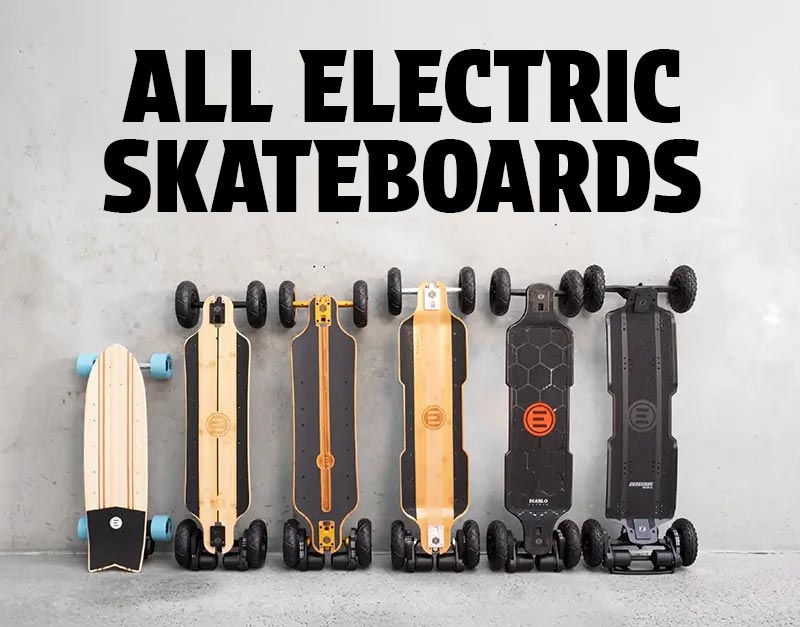
The Diablo Bamboo Street is not the most hardcore board Evolve makes. The Diablo Carbon adds a rigid forged carbon deck and drops weight to 29 lbs for riders who want maximum stability at high speed. The Renegade Diablo takes the same powertrain off-road with wider trucks and binding compatibility.
But for street riding, the Bamboo Street sits at the point where performance and feel are genuinely balanced. It weighs 31 lbs, tops out at 31 mph in production configuration, and handles the kind of varied riding that most people actually do: commuting, long weekend rides, carving through neighborhoods, handling whatever gradient comes up.
If the GTR Bamboo is the right tool for someone starting out or working with a tighter budget, the Diablo is the board for someone who has outgrown the limitations of that generation or simply wants to start at the top.
People also ask
Is the Diablo Bamboo worth the upgrade from a GTR Bamboo?
Yes, for most riders who want more range, smoother power delivery and better hill capability. The Diablo Bamboo Street runs a larger 864Wh battery, upgraded EFOC 2.0 controller and dual 3,500W motors versus the GTR's 3,000W setup. The real-world difference is noticeable in both range and how the board behaves under load.
What is the top speed of the Diablo Bamboo Street?
The Diablo Bamboo Street is governed at 31 mph in production configuration on street wheels.
Can the Diablo Bamboo Street handle hills?
Yes. It is rated for gradients of 45 percent or more, which covers most urban inclines including steep residential streets in cities like San Francisco and Los Angeles.
Does the Diablo Bamboo Street come with lights?
Yes. Front and rear LEDs are built into the board and are customizable through the Explore app. Older Evolve boards did not include integrated lighting.
Where can I try the Diablo in the US?
Evolve has a retail store in Oceanside, CA where you can see the current lineup in person. Online orders ship nationally.
The Diablo Bamboo Street is the version of the electric skateboard that older hardware was pointing toward. Better battery chemistry, a more refined controller, stronger motors and a deck that genuinely rewards carving. For riders who want to understand the gap between then and now, getting on one is the clearest answer.
-
Posted in
electric skateboard, evolve
