

How micromobility is changing the way cities move
How micromobility is quietly rewriting the rules of city travel
Most conversations about micromobility start with scooters cluttering sidewalks or bike share docks sitting empty when you need one. That framing misses the bigger shift happening underneath. Cities are not just adding new vehicles to the mix, they are rethinking what "transportation" even means for trips under five miles, and that rethink is changing infrastructure, commuting habits and the economics of getting around in ways most people have not fully clocked yet.
The last mile problem was never really solved
Public transit has always struggled with the same weak point. A subway or bus line can get you within a mile or two of your destination, but that final stretch, the walk from the station to the office, the gap between the bus stop and the apartment, has historically meant either a long walk or a car you did not really want to drive. Planners call this the last mile problem, and for decades the only real answer was "walk faster" or "own a car."
Electric skateboards, e-bikes and scooters changed that math. A five mile trip that used to mean either a 25 minute car ride through traffic or a 90 minute round trip walk now takes 15 to 20 minutes on an electric board, with no parking search and no gas station stop. That is not a marginal improvement, it is a different category of trip entirely, and it is why last mile transport has become its own planning discipline in city transit departments rather than an afterthought.
Battery technology made this possible, not just good intentions
None of this works without the batteries getting genuinely better. A decade ago, personal electric vehicles were heavy, short range and slow to charge. That has changed substantially. Modern lithium cells, the same Samsung 50S cells used across a lot of the electric skateboard category, pack enough energy density that a board weighing around 12 to 14 lbs can carry a battery good for 40 to 60 miles of real-world range depending on terrain and riding style.
That range number matters more than people realize. It is the difference between a device that works for one specific commute and one that works for however your week actually unfolds, errands included, detours included. Dual motor setups in the 3000W to 3500W range per motor also mean these boards can climb real hills, not just cruise flat bike paths, which is a big part of why they work as genuine transportation and not just recreational gear.
Cities are built for this, whether they meant to be or not
Los Angeles is the clearest example of a city that was designed around the car and is now quietly adapting around something smaller. The sprawl that makes LA hard to walk is exactly what makes electric boards useful there, since a lot of trips that would take 40 minutes on foot become 10 minute rides, and the wide, well paved boulevards give riders room to move confidently.
San Francisco poses a different test entirely. Its hills used to rule out anything without a strong motor, but boards with real hill grip, the kind that can handle a 30 to 45 percent gradient, have made neighborhoods like Nob Hill or the Mission genuinely rideable in a way that a standard e-scooter often is not. New York's density cuts the other way. Trips are shorter, but sidewalks and bike lanes are more contested, which is why compact, easy to carry boards matter more there than raw range.
Austin and Miami show yet another pattern, both younger cities in transit terms, both building out bike lane networks faster than their older counterparts, and both seeing genuine growth in commuters who ride an electric board to a train stop or office rather than driving the whole way. None of these cities set out to become micromobility cities. They are becoming that anyway, because the infrastructure they already had, wide streets, flat coastal paths, growing bike lane networks, happens to suit it.
The commuting math is shifting, not just the vehicles
The real story is not that people are buying electric skateboards instead of cars. It is that the calculation people run before choosing how to get somewhere has changed. Gas, insurance, parking and maintenance on a car add up to a real monthly number, and for a huge share of urban trips, that math no longer wins against a board that costs a few cents in electricity to charge and takes four hours to top up overnight.
Range anxiety, the worry about not making it home on a charge, used to be the main objection. It is a smaller concern now than it was, partly because riders have gotten better at reading their own usage, and partly because boards with all-terrain tires and larger battery packs have made mixed-surface commuting realistic rather than theoretical. A rider who used to need a car for a trip that included a gravel path or an unpaved shortcut can now do that same trip on a 2-in-1 setup, swapping between street wheels and pneumatic tires depending on the day.
What this means for the average commuter
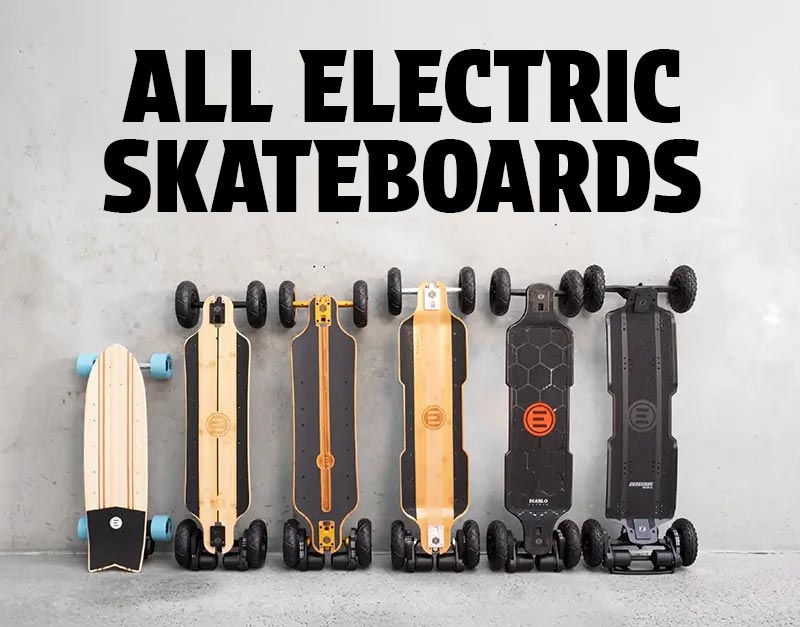
The practical upshot is that a huge number of trips previously assumed to require a car do not. A trip to a train station, a loop through a business district, a ride between a parking structure on the edge of downtown and an office in the middle of it, these are all now firmly in the range of what a well built electric board can handle without drama. Evolve's bamboo boards lean into that everyday use case, with flex decks that absorb road vibration and make longer commutes comfortable rather than jarring. Riders who want more rigidity at higher speeds tend to prefer carbon decks, which stay planted through fast, confident lines rather than flexing underfoot.
The commuters actually driving this shift are not extreme sports riders. They are people who got tired of circling for parking, tired of transit delays, and found that a board covering 10 to 20 miles a day fits their life better than either alternative. That is a quieter, less dramatic story than headlines about scooter pile ups, but it is the one that actually explains why micromobility keeps growing instead of fading as a trend.
Where this actually goes
Cities are not going to stop building for cars anytime soon, but the gap between "car city" and "micromobility city" is narrowing every year, and it is narrowing because the vehicles got good enough to trust, not because anyone mandated a change in behavior. The commute that used to require a car increasingly does not, and that is a bigger deal than most transit conversations give it credit for. Anyone still assuming electric boards are a novelty is working from an outdated picture of what these things can actually do.
-
Posted in
electric skateboard, evolve
