

Onewheel, e-scooter, e-skate or e-bike: which actually suits your life
Onewheel, e-scooter, e-skate or e-bike: how to actually choose
Ask ten riders which type of electric ride is best and you will get ten confident, contradictory answers. That is because the question is wrong. There is no universal best. There is only the ride that matches your commute, your storage situation, your tolerance for learning a new skill, and the terrain you actually cover every day. Once you frame it that way, the decision gets a lot easier.
Each of these four categories, Onewheel-style boards, e-scooters, electric skateboards and e-bikes, solves a genuinely different problem. They overlap just enough to confuse people shopping by feature list. They diverge just enough that picking the wrong one means a garage decoration instead of a daily ride.
The real variable is balance, not speed
Every comparison article leads with top speed and range, but the first fork in the road is simpler: how do you want to stand on it, if you stand at all.
A one-wheeled self-balancing board asks you to lean into turns and trust the board's gyroscopic balancing to keep you upright. It is closer to snowboarding than skating, and the learning curve reflects that. Most new riders need real practice time before they feel confident, and falls are part of the process.
An e-scooter asks nothing of your balance beyond standing on a platform with a handlebar in front of you. It is the lowest-friction option to pick up, which is exactly why cities are full of them.
An electric skateboard sits in between. You need basic skateboard or longboard balance, foot positioning that shifts your weight for turns, and comfort riding without a handlebar. If you have ever ridden a longboard, the transition is quick. If you have never stood on a board of any kind, expect a short adjustment period, shorter than a Onewheel, longer than a scooter.
An e-bike asks for the least new learning of all, because pedaling and steering with a handlebar is a skill almost everyone already has. That familiarity is the entire appeal.
Range numbers hide the real question
Manufacturers publish maximum range figures achieved under ideal conditions: flat ground, a lighter rider, gentle throttle. Real-world range is usually lower, and the gap matters more for some categories than others.
E-scooters commonly land in the 15 to 25 mile range for real-world commuting use, which suits short urban hops well but runs thin on longer routes. Onewheel-style boards vary by model, but riders typically plan around similar short-to-medium distances given the constant balance correction draining the battery.
Electric skateboards span a wider range depending on battery size and wheel setup. A board built around an 864Wh battery pack can deliver up to 80 miles on street wheels in ideal conditions, dropping to roughly 50 miles once you switch to all-terrain tires, which draw more current from the motors due to rolling resistance. A lighter setup built around a 648Wh pack lands closer to 60 miles on street wheels and around 40 on all-terrain. Either way, plan around the lower number, not the headline one.
E-bikes generally win the range conversation outright, especially with pedal assist doing part of the work instead of the motor alone. A mid-drive e-bike with a 345Wh battery can still reach up to 37 miles with pedal assist because you are sharing the load, not asking the motor to do everything.
The honest way to think about this: if you can charge at your destination, a smaller battery is rarely a problem. If you cannot, buy more range than you think you need.
Portability decides more rides than performance does
Nobody skips a ride because top speed was too low. They skip it because the thing is a pain to carry, store or lift up three flights of stairs.
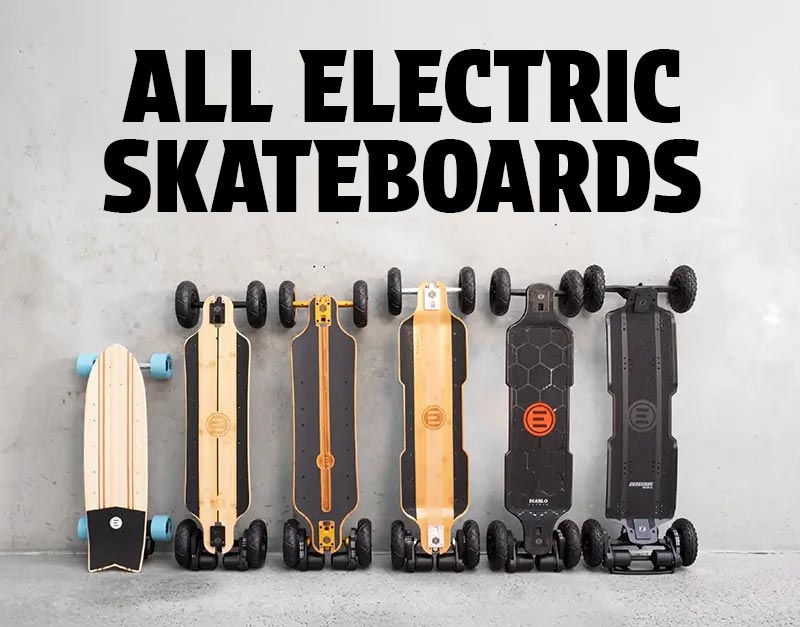
E-scooters fold flat and roll on their own wheels, which makes them the easiest to bring onto a train or tuck under a desk. Electric skateboards do not fold, but a well-built one built around a bamboo deck can weigh around 27 lbs, light enough to carry under one arm through a subway turnstile or up an apartment stairwell without it becoming a workout. Carbon decks shave weight further while adding rigidity, which matters more at speed than at rest.
Onewheel-style boards are compact in length but tend to be dense and awkward to carry for long stretches, since all the weight sits in one central housing. E-bikes are the heaviest of the group by a wide margin, with a mid-drive frame commonly running around 45 lbs. That is fine if it lives in a garage or gets locked outside. It is a genuine problem if you are hauling it up to a third-floor walk-up every night.
Hills and stability change the calculus
Flat ground makes everything look equally capable. Hills expose the differences fast.
Dual-motor electric skateboards built for hill climbing can manage gradients above 30 to 45 percent depending on the motor and battery configuration, which covers almost anything you will encounter riding through hilly parts of San Francisco or the climbs around Los Angeles's east side. That kind of torque comes from having two motors working independently on the rear wheels, not one shared motor trying to do the job of two.
E-scooters generally have less climbing power, since most run a single hub motor, and steep hills can noticeably sap both speed and range. Onewheel-style boards handle moderate inclines reasonably well thanks to their self-balancing system actively managing pitch, but they are not built around the same raw torque figures as a dual-motor board. E-bikes handle hills comfortably because pedal assist means the motor and your legs are sharing the climb, which is part of why they feel so effortless on long, rolling routes.
What each one is actually good at
An e-scooter is the right call if your ride is short, flat, and mostly about getting from a subway stop to an office door. It asks the least of you and gives back exactly that: convenience, not character.
A Onewheel-style board suits someone who wants the feel of snowboarding or surfing translated to pavement and trail, and who is willing to invest real time in learning balance before it becomes second nature.
An electric skateboard is the pick for riders who want genuine carve feel, direct control through the feet, and a setup that can be tuned between street wheels and all-terrain tires depending on the ride. It rewards riders who want engagement, not just transportation.
An e-bike, including something like Evolve's Project BMX with its Bafang mid-drive motor and pedal-assist power delivery, suits longer routes, cargo needs, and riders who want a familiar bike experience with the effort dialed down. It is also the only category here still shipping in a form with real everyday practicality baked into the geometry rather than added as an accessory.
Where you actually ride matters more than any spec sheet
A rider commuting through Austin's wide, flat sprawl has very different needs from someone weaving through Manhattan traffic or climbing the hills out of downtown Los Angeles. Miami's flat grid and frequent rain call for different tires and different water tolerance than the dry hill climbs of the Bay Area. None of these four categories is universally right for American cities. Each one is right for a specific kind of route.
If you want low effort and easy storage, get a scooter. If you want a genuine feel-good ride and don't mind the learning curve, a one-wheeled board delivers something no other category does. If you want control, carve, and a setup you can tune for street or trail, an electric skateboard is the more engaging tool. And if your ride is long, your cargo matters, or you just want a bike that happens to have a motor, an e-bike wins every time. Buy for your commute, not for the spec sheet, and you will actually ride the thing you bought.
-
Posted in
electric skateboard, evolve
