


Sensored brushless motors: what they do for your ride

Why sensored brushless motors change the way an electric skateboard actually feels
Most riders shopping for an electric skateboard focus on top speed and range. Those numbers are easy to compare and easy to understand. What gets less attention is the motor technology underneath, and specifically whether the motors are sensored or sensorless. That distinction shapes almost everything about how the board responds to you, especially in the moments that matter most.
It is worth understanding what sensored brushless motors actually do before you buy, because once you ride a board equipped with them, going back feels like riding with your eyes half closed.
The problem that sensors solve
A brushless motor works by sending electrical pulses to rotating magnets in a precise sequence. The motor controller needs to know exactly where those magnets are at any given moment to time the pulses correctly. Without that information, it is essentially guessing.
Sensorless motors handle low-speed movement poorly for this reason. The controller relies on back-EMF, the electrical signal generated by a spinning motor, to estimate rotor position. But at low speeds and at a standstill, there is not enough back-EMF to read accurately. The result is hesitation on takeoff, a slight lurch when you first apply throttle, and inconsistent response when you are rolling slowly through traffic or creeping up a driveway cut.
Sensors eliminate the guesswork entirely. Hall effect sensors sit inside the motor housing and report rotor position directly to the controller in real time. The controller always knows exactly where the magnets are, regardless of speed. That means smooth, confident power delivery from the moment you push off, with no hesitation and no lurching.
What this feels like when you are actually riding
The difference is most obvious in two situations: low-speed throttle application and stop-start urban riding.
On a board with sensorless motors, there is a brief dead zone at the start of throttle input where the board seems to think about it before responding. On a sensored board, the response is immediate and proportional. You press the trigger and the board moves, cleanly and predictably. That sounds like a small thing until you are riding alongside traffic in San Francisco or filtering through the slow-moving grid of Midtown Manhattan, where delayed response at low speed is genuinely unsettling.
The other place it shows up is hill starts. If you slow to a near stop on a gradient and then apply throttle again, a sensorless motor can stutter or hesitate as the controller tries to re-establish position sensing. A sensored motor handles this without drama. The board just goes. For anyone commuting through hilly neighborhoods in Los Angeles or Austin, that reliability is not a technical detail, it is a practical necessity.
Sensored motors and braking work together
Regenerative braking on an electric skateboard works through the same motor system, running current in reverse to slow the board and feed energy back to the battery. Sensored motors improve braking consistency for the same reason they improve acceleration: the controller has precise positional data at all times.
On a board with sensored motors and a well-tuned controller like Evolve's EFOC 2.0, braking feels linear and progressive. You can apply light pressure for a gentle slowdown or squeeze harder for sharper deceleration, and the response matches your input accurately. On a busy shared path in Miami or a downhill stretch in the hills above Los Angeles, that predictability is the difference between a comfortable ride and a white-knuckle one.
The GTR Bamboo 2-in-1 as a practical example
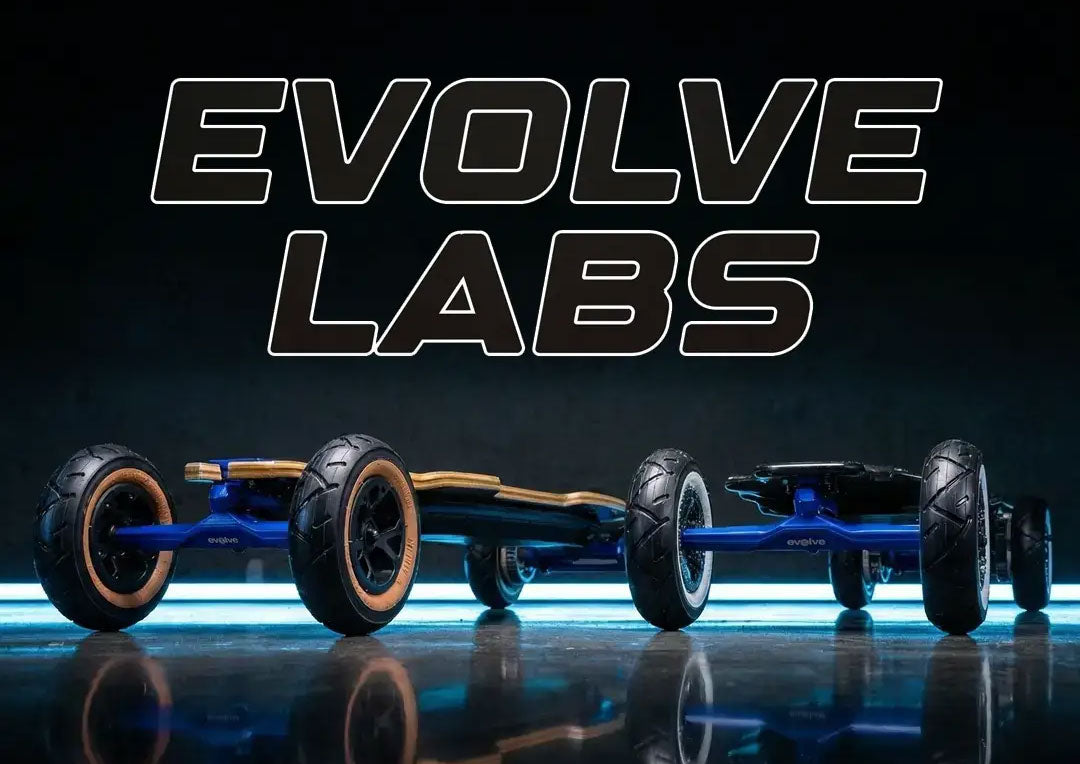
The GTR Bamboo 2-in-1 runs dual 6368 brushless sensored motors, each rated at 3000W, paired with FOC commutation and Bluetooth connectivity. The motor technology here is not a premium add-on. It is standard across the lineup because Evolve does not build boards with sensorless motors.
What that means in practice is a board that starts smoothly, brakes predictably and handles low-speed throttle input with the kind of precision that makes urban riding feel natural rather than stressful. The GTR has been in the lineup long enough to prove itself as a daily rider, and much of that reliability traces back to the motor and controller setup.
The 2-in-1 configuration is worth paying attention to here. The board ships with both 97mm street wheels and 175mm pneumatic all-terrain tires. You get up to 50 miles of range on street and up to 19 miles on the all-terrain setup. The sensored motor system handles both wheel configurations without any reconfiguration on the controller side, because position sensing does not depend on wheel size or rolling resistance. Switch to the all-terrain tires for weekend trail riding outside Austin or a packed-gravel path in Central Park, and the motor response stays consistent.
At just over 11 lbs in street configuration, the GTR Bamboo is also a board you will actually carry. That matters when you are navigating the subway in New York or grabbing a BART train in San Francisco.
FOC versus traditional commutation
One more technical point worth understanding: sensored motors deliver their full benefit only when paired with a controller using Field Oriented Control, which Evolve calls FOC. Traditional trapezoidal commutation sends current in broad steps, which creates slight torque ripple and audible motor noise. FOC uses the sensor data to apply current continuously and smoothly, producing a quieter, more efficient motor with genuinely smoother output at all speeds.
The practical result is a board that is noticeably quieter than older controller architectures, and one that runs more efficiently because less energy is lost to heat and torque variation. The 504Wh battery on the GTR Bamboo already delivers strong real-world range on street wheels. FOC helps it go further by extracting more work from each charge cycle.
It matters more than most specs you will compare
Motor type does not appear on most entry-level product pages, and that absence is meaningful. A lot of boards in the GTR's price bracket use sensorless motors and older controller architectures because the components are cheaper. You will not feel that difference on a spec sheet. You will feel it the first time you apply throttle from a standstill on a slight incline and the board hesitates under you.
If you are evaluating the GTR Bamboo 2-in-1 against other boards in this range, sensored brushless motors with FOC commutation is the detail worth holding onto. It is the engineering decision that shows up most clearly in everyday riding, and it is the kind of thing you only fully appreciate after you have experienced the alternative.
For a versatile daily board that handles both sealed streets and light off-road riding without asking you to compromise on how it feels underfoot, the GTR Bamboo 2-in-1 is a considered choice. The motor technology is a big part of why.
-
Posted in
electric skateboard, evolve
