


Watt-hours explained: how to read battery specs

Watt-hours explained: what that number on your board's battery actually means
When riders start comparing electric skateboards, the spec sheet becomes a wall of numbers fast. Voltage, amp-hours, cell count, peak wattage. Most of it gets glossed over. But one figure quietly determines more about your riding experience than almost anything else on the list: watt-hours.
Understanding it does not require an engineering background. It just requires someone to explain it honestly, because the way battery specs get presented in most product listings is not particularly useful to a rider trying to make a real decision.
What a watt-hour actually measures
A watt-hour is a unit of energy. Specifically, it measures how much power a battery can deliver over time. One watt-hour means the battery can supply one watt of power for one hour, or two watts for thirty minutes, or half a watt for two hours. The number scales in both directions.
On an electric skateboard, the watt-hour figure tells you the total energy stored in the pack. A 432Wh battery holds less energy than an 864Wh battery, full stop. Everything else being equal, more watt-hours means more riding before you need to plug back in.
The reason this matters more than just looking at the range figure is that range claims are always conditional. Terrain, rider weight, riding mode, wind, and wheel type all change how quickly that stored energy gets used. Watt-hours give you the raw capacity. Range is what you do with it.
Why voltage and amp-hours alone can mislead you
Battery specs often get broken down into two separate numbers: voltage and amp-hours. A battery listed as 43.2V and 20Ah sounds like two different measurements of two different things, and in a sense, they are. But neither one tells you the full picture on its own.
Watt-hours combines them: voltage multiplied by amp-hours gives you total energy. So a 43.2V, 20Ah pack works out to 864Wh. That is the number worth comparing across different boards, because voltage and amp-hours can be tuned in ways that make a smaller battery look bigger on paper if you only read one of the two figures.
When someone tells you a board has a "20Ah battery," ask what voltage it runs at. When they lead with voltage, ask for the amp-hour rating. The watt-hour figure is the honest summary of both.
How terrain changes what that number is worth
This is where things get practical. Two boards with the same watt-hour rating will deliver different real-world range depending on what they are rolling on. Street wheels on smooth asphalt are efficient. Pneumatic all-terrain tires on dirt, gravel, or grass create more rolling resistance and pull harder from the battery to maintain speed.
A board rated at 80 miles on street wheels might deliver closer to 31 miles on all-terrain tires. That is not a flaw in the battery. It is physics, and it is worth understanding before you plan a long ride.
If you are riding mixed terrain in Austin's Barton Creek Greenbelt or doing fire road laps outside Los Angeles, you will use energy faster than someone cruising the Hudson River Greenway in New York on sealed concrete. Same board, same battery, different energy draw. The watt-hour figure stays the same. How far it takes you depends on what you are asking it to do.
Cell quality is part of the equation too
Raw watt-hour capacity matters, but so does what is inside the pack. Not all cells are equal. Premium cells hold voltage more consistently under load, which means the board feels strong throughout the ride rather than sluggish toward the end of a session. Cheaper cells can sag significantly when the battery drops below 50 percent, which affects speed and braking response in ways that are hard to predict.
Samsung 50S cells are widely regarded as one of the most capable options currently available for high-drain applications. They handle sustained current draw without the voltage drop that compromises performance at the top and bottom of the charge range. For an aggressive rider pushing hard on varied terrain, that consistency is noticeable.
Where the Diablo Carbon All-Terrain sits in this context
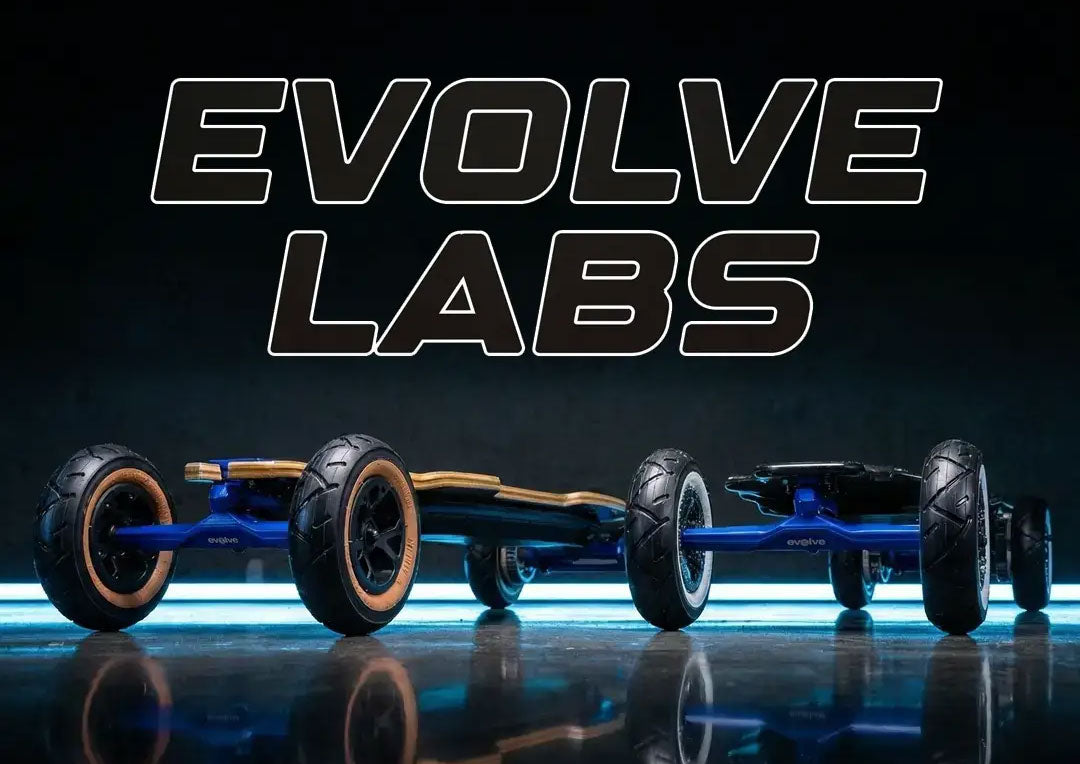
Most boards in this category ask you to make a tradeoff. You can have a big battery, or you can have a light board, but rarely both. The Diablo Carbon All-Terrain is one of the few setups that manages a genuine 864Wh Samsung 50S pack in a board that weighs 31.6 lbs. That is a meaningful amount of energy storage without the weight penalty that usually comes with it.
On all-terrain tires, it delivers up to 31 miles of real-world range. That covers a serious off-road session comfortably and still gets you home. The forged carbon deck plays a part here too. It eliminates flex entirely, which means the board does not absorb energy in the deck the way a bamboo setup does under load. At speed on rough ground, that translates to more predictable power delivery and a platform that stays planted when you need it most.
The dual 3,500W motors handle gradients above 45 percent, which sounds extreme until you are looking at a San Francisco hill or a rocky trail climb and suddenly wishing you had more power than you needed rather than less. The EFOC 2.0 controller manages torque delivery smoothly enough that you are not fighting the board when the terrain gets inconsistent.
Reading the spec sheet like a rider, not an engineer
When you are comparing boards and you hit the battery section, here is a practical way to work through it. Find the watt-hour figure first. If it is not listed directly, multiply the voltage by the amp-hour rating. That gives you a baseline for comparing total energy across different boards on equal terms.
Then look at the range claim and ask what conditions it assumes. Street or all-terrain. Flat or hilly. Light rider or heavier load. A board with an 864Wh pack will behave differently at 160 lbs on flat Miami paths versus 220 lbs in the Santa Cruz hills. Neither scenario is wrong. They just use energy at different rates.
Finally, consider charge time relative to your riding pattern. An 864Wh pack on a 5A fast charger takes around four hours to refill. For most riders, that fits within a normal day. For riders who want to do two sessions in a row, it is worth planning around.
Battery specs stop being intimidating once you understand what each number is actually measuring. Watt-hours is the one that tells the truth. Everything else just adds context.
If you are riding serious terrain and want a setup that does not ask you to compromise on capacity, weight, or performance, the Diablo Carbon All-Terrain is the honest answer. It has the battery to back up its ambitions, and the platform to make use of it.
-
Posted in
electric skateboard, evolve
