

What to look for when buying an electric skateboard

What to Look for When Buying an Electric Skateboard
The most important things to look for in an electric skateboard are motor power, battery range, deck feel, and how well the board matches your actual riding environment. Most buyers focus on top speed and miss the factors that define daily ride quality. This guide breaks down what genuinely matters, with a clear recommendation at the end for riders who want one board that handles most situations.
Start with where and how you ride
Before comparing specs, be honest about your terrain. A board tuned for smooth bike paths in Miami performs differently than one dealing with cracked sidewalks in New York or rolling hills in San Francisco. Street wheels are faster and more efficient on sealed surfaces. All-terrain wheels handle rougher ground but reduce top speed and range.
If your commute or riding environment changes, a 2-in-1 setup covers both. You get one board with two wheel configurations and swap between them as needed. That flexibility changes the calculus on what counts as value.
Motor power and what it actually means
Raw wattage numbers get thrown around a lot in electric skateboard marketing. What matters more is how the power is delivered. Smooth, controllable acceleration is safer and more enjoyable than aggressive throttle response that throws you off on the first push.
Look for boards with brushless sensored motors. They provide feedback to the controller from the moment the motor starts moving, which translates to smoother low-speed control and better braking. Hill climbing matters too, especially in cities like Los Angeles or San Francisco where flat ground is a generous assumption. A motor rated for 35 percent gradient or higher will handle most real-world inclines without struggling.
Range and the battery behind it
Advertised range figures are usually measured under controlled, favorable conditions. Real-world range depends on your weight, terrain, riding mode, and how aggressively you accelerate. As a rough guide, expect to achieve around 60 to 75 percent of the stated maximum in normal riding.
Battery capacity is measured in watt-hours. Higher is better, but it adds weight. A 648Wh battery hits a practical sweet spot for most commuters and weekend riders, offering meaningful range without making the board difficult to carry. Also check charge time. A 4-hour charge on a fast charger is manageable. Slower charging setups can become an inconvenience if you ride daily.
Deck material and ride feel
The deck is what connects you to the board, and the material changes everything about how a ride feels underfoot.
Bamboo decks have natural flex. They absorb road vibration, respond intuitively to weight shifts, and give a surf-style carve feel that makes longer sessions genuinely enjoyable. Carbon decks are stiffer and more stable at high speeds, which suits aggressive riders or heavier builds, but they transmit more road feedback directly to your feet.
For most riders, bamboo is the more forgiving choice and the better place to start. The flex also makes it easier to modulate turning, which builds confidence quickly.
Trucks and stability
Trucks control how the board turns and how stable it feels at speed. Forged and CNC-machined trucks are stronger and more precise than cast alternatives. Double kingpin geometry gives a more responsive, carvy feel compared to traditional single kingpin setups.
Adjustable wheelbase is worth looking for if you plan to switch between riding styles. A longer wheelbase adds stability at higher speeds. A shorter one makes the board more nimble in tighter spaces. Some boards let you shift the truck position to find the balance that works for your stance and use case.
Remote and app control
The remote is your direct interface with the board. A well-designed remote with a clear LCD display, dual-trigger layout and reliable Bluetooth connection makes a real difference. You want to know your speed, battery level and riding mode at a glance without fumbling.
App compatibility matters for tuning. Being able to adjust acceleration curves, braking strength and riding modes through a smartphone app means the board adapts to your skill level and preference over time, rather than locking you into factory settings.
Weight and portability
Electric skateboards are heavier than traditional boards. Weight affects how easy the board is to carry on a subway, into an office, or up stairs. Anything under 13 lbs is genuinely light for a full-performance board. In the 25 to 30 lb range, the board is rideable but becomes a commitment to carry.
If you commute in Austin, New York, or anywhere that involves combining your board with public transit, weight is worth prioritizing alongside performance specs.
The board that covers most of this well
The Evolve Fusion 2-in-1 is one of the most practical answers to the buying question for riders who want genuine performance without committing to either a street or off-road setup.
It runs dual 3000W brushless sensored motors through an EFOC 2.0 controller, which means responsive, smooth power delivery at both ends of the throttle. The 648Wh Samsung battery delivers up to 37 miles on street wheels and 25 miles on all-terrain, with a 4-hour charge time. Top speed in street configuration is 31 mph, dropping to 26 mph on the all-terrain setup.
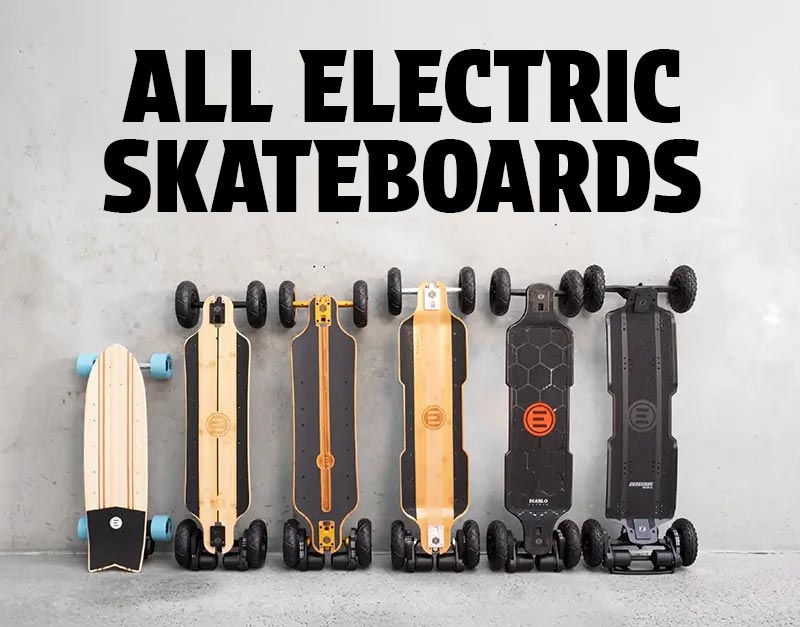
At 27.5 lbs on a 96 cm bamboo deck, it sits in a comfortable middle ground between the heavier flagship Diablo series and the more compact Stoke X. The SuperCarve 2.0 trucks with an adjustable 36 to 37-inch wheelbase let you dial in the feel. The Phaze remote and Explore app handle tuning, ride tracking and mode adjustments.
The 2-in-1 configuration includes both 97mm street wheels and 175mm pneumatic all-terrain tyres in the box. That means one purchase covers sealed bike paths, grass sections, gravel trails and uneven urban surfaces. For a rider in Los Angeles dealing with a mix of smooth coastal paths and rougher neighborhood streets, or someone in Miami where conditions change block by block, that versatility is genuinely useful rather than just a spec on a page.
The 120 kg max load rating also gives heavier riders full access to the platform without range or performance penalties.
A few things worth checking before you buy
- Verify the warranty period and what it covers. Evolve includes a 12-month warranty and a 14-day money-back guarantee.
- Confirm whether the battery qualifies for air travel if that matters to you. Most current performance boards, including the Fusion, exceed airline battery limits.
- Check whether spare parts, belts and conversion kits are available from the brand directly. Serviceability matters over the long run.
- If you want to see the board in person before buying, Evolve's US retail store is in Oceanside, CA.
If you want one board that handles varied terrain, offers real commuter range and doesn't require a second purchase when your riding style evolves, the Fusion 2-in-1 is the most practical choice in the current lineup. It isn't the cheapest option and it isn't the most powerful, but it answers more of the buying criteria on this list than any other single configuration.
See the Fusion in action
-
Posted in
electric skateboard, evolve
