

Why electric skateboard wheels make such a big difference

Why the wheels on your electric skateboard matter more than you think
Most riders focus on motors, battery and top speed when choosing an electric skateboard. Wheels are an afterthought. That's a mistake, because the contact patch between your board and the ground shapes almost everything about how a ride actually feels.
Acceleration response, braking confidence, vibration through your feet, grip on rough pavement, how the board handles a wet drain cover or a patch of gravel: all of that runs through the wheels before it ever reaches the motors or the deck. Getting the wheel choice right is one of the highest-leverage decisions you can make.
Street wheels and all terrain tires are fundamentally different tools
Street wheels are solid urethane, typically 85mm to 107mm in diameter. They roll fast, respond quickly to throttle input and hold speed efficiently on smooth asphalt. The trade-off is that every crack, root or rough patch transmits directly to your feet. On clean urban surfaces they feel quick and alive. On anything less than smooth, they start to work against you.
All terrain tires are pneumatic, around 175mm, and behave more like a mountain bike tire than a skateboard wheel. They absorb surface irregularities, grip loose ground and give you a noticeably softer, more planted ride. You lose some top speed and range compared to street wheels on the same board, but you gain capability and comfort that urethane simply cannot replicate.
These aren't two points on the same spectrum. They're different riding experiences built for different environments.
How wheels change what the motors and battery actually deliver
Wheel size and type directly affect how the board's drivetrain performs. Larger diameter wheels cover more ground per motor rotation, which changes acceleration feel even with identical motor output. Pneumatic tires create more rolling resistance than urethane, which is why all terrain range figures run lower than street range on the same battery.
That relationship matters practically. On the Diablo Bamboo, dual 3500W motors and an 864Wh Samsung battery deliver up to 50 miles of real-world range on street wheels. Swap to all terrain and that figure comes down to around 31 miles, with 45%+ hill climbing still intact. Neither setup is worse. They're optimized for different demands.
The motor and battery are fixed. The wheels are the variable that lets you tune the board to the terrain in front of you.
What this looks like across different environments
In Los Angeles, most riding happens on smooth bike lanes and wide flat streets where 97mm street wheels are the obvious choice. You get fast roll speed, tight response and efficient range for longer sessions along the coast or through the neighborhoods.
San Francisco is a different equation. The hills are steep, the pavement varies wildly between blocks and you're regularly crossing cable car tracks and expansion joints. All terrain tires handle the surface variation better and the Diablo's 45%+ gradient capability handles the climbs.
In New York, you're navigating a constant mix: smooth stretches interrupted by manhole covers, uneven crosswalks and the occasional stretch of cobblestone. A 2-in-1 setup means you're not locked into one wheel type when the terrain keeps changing.
Austin's trails and Miami's beach paths both benefit from all terrain capability, especially anywhere riders venture off sealed surfaces.
The case for carrying both
The practical problem with choosing between street and all terrain has always been commitment. Once you've built your board for one surface, switching required buying a full conversion kit separately and swapping drive gears, belts and wheels as a whole system.
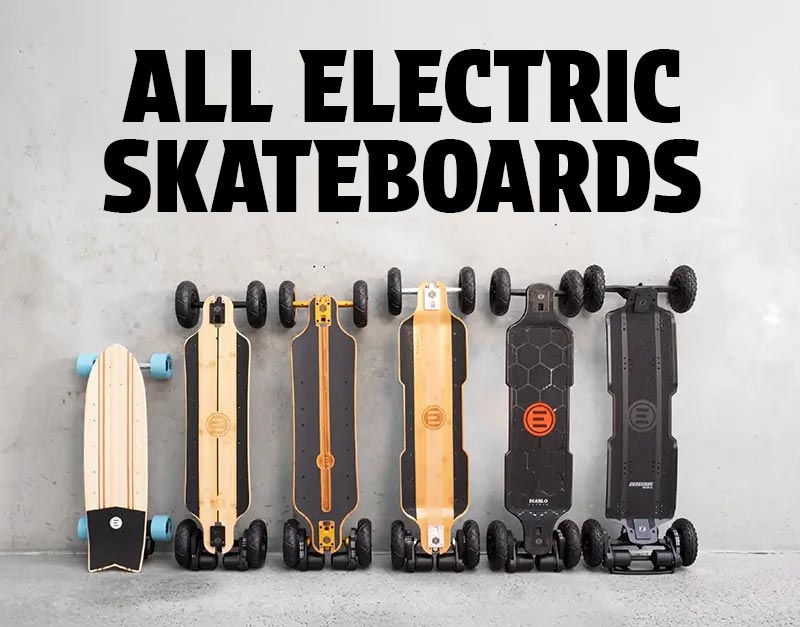
The Diablo Bamboo 2-in-1 solves that by including both complete wheel sets in the box. You get the 97mm street urethane for sealed surfaces and the 175mm pneumatic all terrain tires for everything else, along with the corresponding drivetrain components for each setup. Nothing extra to buy.
The Diablo Bamboo deck itself is 3-ply bamboo with 2-ply fibreglass, which gives you natural flex underfoot. That matters more when you're riding street wheels because the deck absorbs some of what the urethane transmits. On all terrain tires, the pneumatics handle most of the damping. Either way the ride quality holds up.
At 31 lbs in street configuration and 33 lbs in all terrain, it's not a light board. But with a 120 lb max load capacity and motors that can push through 45% gradients, it's built for real riding rather than just looking capable on a spec sheet.
Switching between setups
The conversion process is straightforward with the Y-tool that comes in the box. You're swapping the whole drive system for each wheel type, not just pulling wheels off and on like a traditional skateboard. It takes some time the first few times. After that it becomes routine.
The Phaze remote and Evolve's Explore app let you adjust acceleration and braking curves between setups as well, which is worth doing. Street and all terrain riding have different feedback characteristics and the tuning options let you match the board behavior to what you're actually riding on.
Wheel choice as the starting point, not the finish line
Riders often think of wheel selection as a finishing detail after everything else is decided. It's more useful to think of it as the first question. What surfaces are you riding? What's the mix across a typical week? How much range do you need, and are you willing to trade some for more terrain capability?
Once you've answered those questions honestly, the rest of the spec sheet falls into place around them. A board with a strong battery and dual motors can be unlocked or limited by the wheels it's wearing. The Diablo Bamboo 2-in-1 keeps both options available, which is the most honest way to handle a question that rarely has a single right answer.
-
Posted in
electric skateboard, evolve
